Nigerian multistakeholder platform members pay a visit to the House of Representatives and Senate
28 March 2023

The cross-cutting theme of Science, Policy, & Institutions is integrated into all RFS country projects and is a key focus within the Regional Hub. This theme focuses on fostering a common understanding of key evidence around ecological sustainability and resilience as well as integrating that evidence within relevant policy processes.
The multi-dimensional nature of agriculture and food security within sub-Saharan Africa is inherently complex, involving a wide range of actors, mandates, and priorities that often compete and conflict. Government ministries often work within specific mandates with little cross-sectoral communication, knowledge exchange, and collaboration. This has resulted in policies and institutions that fail to reflect the interconnected nature of climate, environment, agriculture, and food security.
Effective policymaking and public programme implementation is often further challenged by the information and data gaps that exist in African countries due to lack of capacity, lack of funding, or lack of quality control and data harmonisation. In the absence of accessible information and usable evidence, actors with both public and private spheres are often tasked with establishing strategies and action plans without a strong evidence base. This leads to, for example, agricultural policies and incentives programmes that are misaligned with future climate scenarios, resulting in potentially negative impacts, such as the promotion of crops that are ill-suited for future climate realities.
Science, Policy & Institutional interventions aim to bring together the right stakeholders in the appropriate forums to analyse and disseminate scientific and practical evidence in order to effectively align policy and institutional frameworks with realities on the ground. The ultimate goal is to bridge the gap between agricultural and environmental agendas through the promotion of integrated approaches that work to achieve food security, improved incomes, and the protection and rehabilitation of ecosystems in rural communities.
Interventions within this theme involve the establishment and promotion of mechanisms for multi-stakeholder coordination, planning and investment. These mechanisms and platforms provide an opportunity for cross-sectoral dialogue and collective decision-making. RFS country projects are also working to influence existing policy and institutional dialogue processes by improving access to information, facilitating knowledge exchange, and developing institutional capacities.
Within each country, the RFS programme is working to promote dialogue and collaboration between relevant government ministries and stakeholders from the development community, private sector, and civil society. The ultimate aim of this multi-stakeholder collaboration is the development of supportive policies and incentives for smallholder farmers to adopt productive, sustainable and resilient agricultural practices.
In Burkina Faso, the RFS country project team is facilitating national and regional dialogues to support the integration of Land Degradation Neutrality targets within national planning frameworks. The Nigeria team has established a Public-Private Partnership platform for policymakers, civil society actors, and representatives from all links within groundnut and rice value chains to establish sustainable structures and partnerships for value chain development. The Regional Hub has developed a digital Science-Policy Interface to provide up-to-date information to decision-makers and to document best practices for country project teams.
Explore the RFS Country Projects to see more examples of how RFS countries are implementing Science, Policy & Institutions activities.
Stories from the Field
Explore our stories from the field to learn more about how RFS country project teams are implementing activities related to the programmatic theme of Science, Policy & Institutions.
Relevant resources
We have a growing library of reports, briefs, case studies, media, tools and guidelines. Explore all resources related to Science, Policy & Institutions to get greater insight into our programme activities.
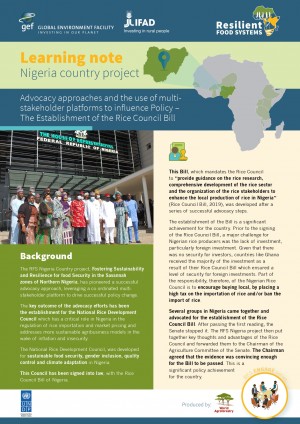
The RFS Nigeria Country project, Fostering Sustainability and Resilience for Food Security in the Savannah zones of Northern Nigeria, has pioneered a successful advocacy approach, leveraging a coordinated multistakeholder platform to drive successful policy change. The key outcome of the advocacy efforts has been the establishment of the National Rice Development Council which has been signed into law with the Rice Council Bill of Nigeria. This Learning Note shares insight into the process and tips for sustainability and scalability for similar advocacy initiatives.
This framework aims to deepen the understanding of country teams to clarify their engagement in leveraging policy, institutional and behavioural change for achieving positive policy, institutional and human behavioural changes necessary to meet resilient food systems objectives. It provides an outline of the fundamental elements in the design and implementation of an advocacy strategy including understanding decision cycles and influence for sustainable land management and agroecological systems; shares experiences reflecting different scales of intervention (national, sub-national, local); and provides examples of how different mechanisms such as multi-stakeholder platforms can be used as an engine of socio-ecological change.
RFS Ethiopia and Uganda present their experiences with creating and managing multistakeholder platforms in their unique contexts.
This presentation was part of Learning Lab 1: Multi-stakeholder engagement processes of the 2022 Resilient Food Systems Annual Workshop in Blantyre, Malawi.
© 2020 Resilient Food Systems.

